Six views of the same reality
These images approach the same reality from different directions.
Across them, individuals, minds, civilizations, systems and histories appear separate, yet remain embedded within structures larger than themselves. Light refracts. Boundaries protect and constrain. Perspectives establish orientation. Puppets pull the strings of other puppets. People occupy the same pool while experiencing different versions of it.
The recurring question is whether separation is as fundamental as it appears from inside the system.
No observer is given a position completely outside reality from which to see the whole. Each encounters it through perspective, relationship, history, consciousness and forces that may never become fully visible. Those limitations do not necessarily make the experience false. They may be what makes experience possible at all.
The works do not propose an answer to what lies beneath these different views. God, physics, consciousness, causality, emergence and something not yet adequately named remain possible ways of approaching the same question.
Perhaps reality does not need to be fully visible from within itself to possess an underlying coherence.
Perhaps we are not outside looking in.
We are inside, trying to see the whole.
Web of Life
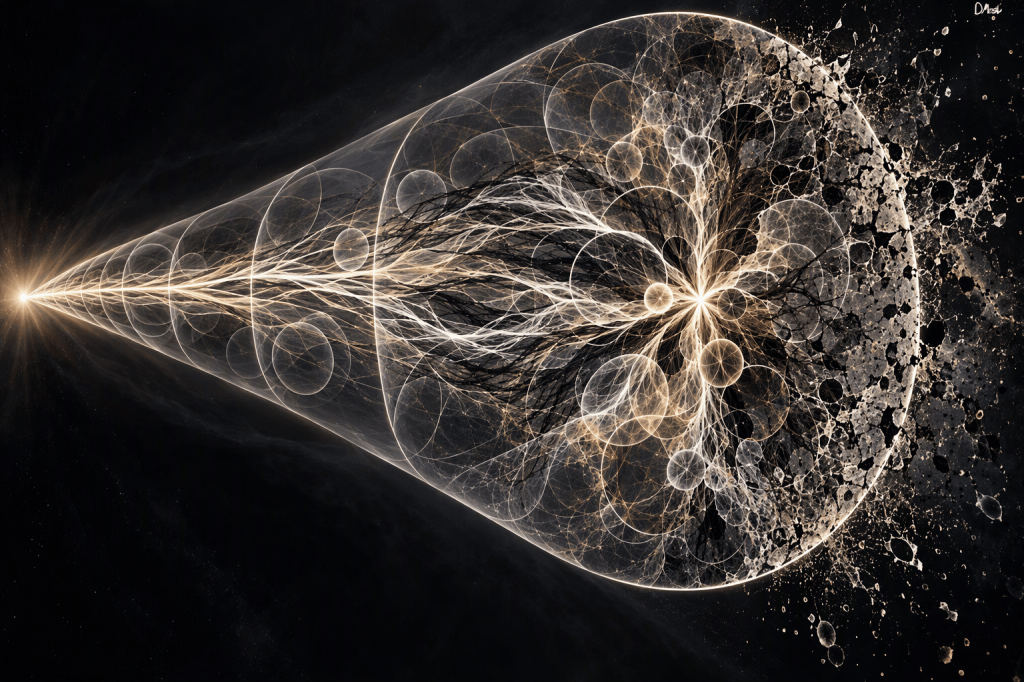
The image begins with a singular point of light. Whether that point represents creation, God, consciousness, or simply an origin is intentionally unresolved. What matters is what follows from it.
The light does not travel through emptiness unchanged. It expands into a field of possible relationships. Circles overlap circles; branches divide and reconnect; individual structures emerge inside larger ones. As the field develops, simple geometry gives way to something resembling an immense living network.
The branching forms can be read as lives, choices, causal paths, or relationships. None develops independently. Every path exists within a structure already shaped by paths that came before it, while simultaneously changing the structure encountered by what comes next. The distinction between the individual and the whole therefore becomes difficult to locate.
The two luminous points create an unresolved symmetry. The first appears to generate the system. The second emerges within it. They may represent fundamentally different things, or the same thing viewed from opposite directions. The image does not decide.
Toward the right, order becomes increasingly difficult to distinguish from disorder. The enclosing structure breaks apart. Connections become tangled, obscured, and fragmented. Yet the network does not simply disappear. Something continues through the fracture.
Web of Life is therefore less a diagram of reality than a question about it: whether the apparent separation of events, lives, choices, and moments is fundamental, or whether those distinctions emerge from a deeper structure of relationships that no observer inside the system can see in its entirety.
Nature of Reality
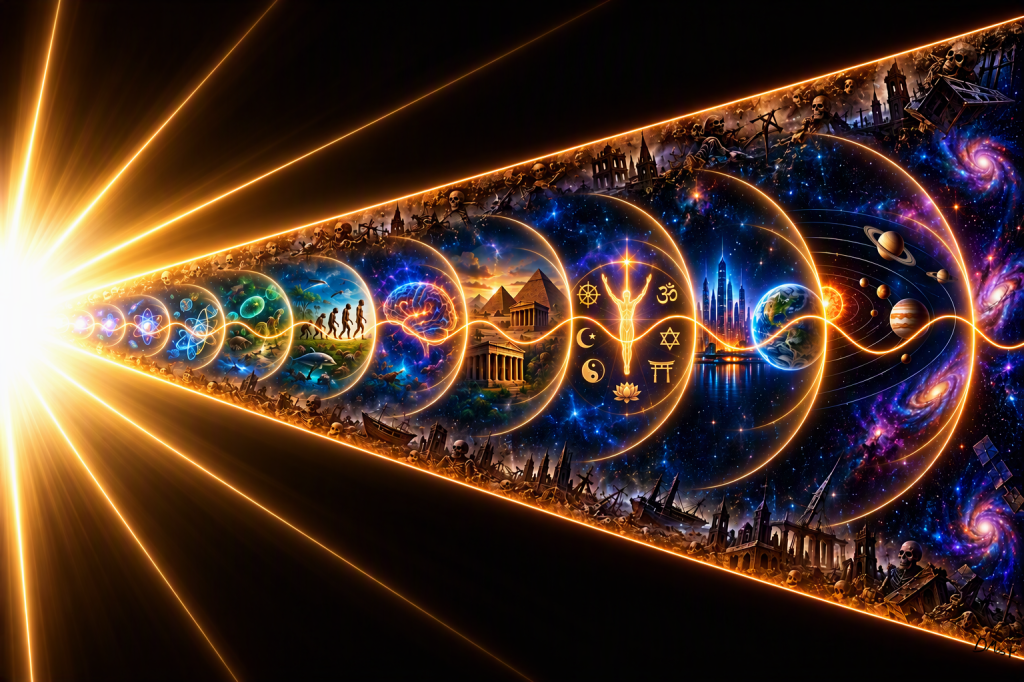
Reality begins here as something undivided.
From a single source, structure emerges in layers. Matter organizes into atoms; atoms into increasingly complex forms; life appears and changes; consciousness emerges; civilizations are built; meaning is sought through religion and culture; worlds and galaxies occupy scales almost beyond comprehension. Each layer seems to contain the one before it while becoming something that could not easily be seen from the earlier level.
A single wave passes through them all. It changes with the structures it encounters, but it never stops being continuous. The suggestion is not that physics, biology, consciousness, history, religion, and cosmology are competing explanations of reality. They may instead be different resolutions of the same reality, made visible at different scales.
The nested boundaries are not only divisions between levels. They are also protective structures. Within each boundary, a system gains enough stability for new forms of complexity to develop and thrive. Matter can organize, life can persist, consciousness can emerge, cultures can grow. The boundary shelters what exists inside it, even as it limits what can be perceived beyond it.
This gives the boundaries a double meaning. They protect, but they also constrain. What allows a system to exist may also define the horizon from which that system understands reality. The boundaries can therefore be read as stages in time, levels of emergence, limits of observation, or simply the categories imposed by a mind trying to understand something that may not actually be divided.
Along the edges runs another continuity: ruin, death, collapse and disappearance. These are not placed outside creation. They belong to the same structure. What appears to be an ending at one scale may be transformation when viewed from another.
The image therefore leaves its source deliberately undefined. God, energy, information, possibility, or something for which none of those words is adequate might occupy the same visual position.
The question is not simply what reality is, but whether all the different things we call reality are separate things at all.
Orientation
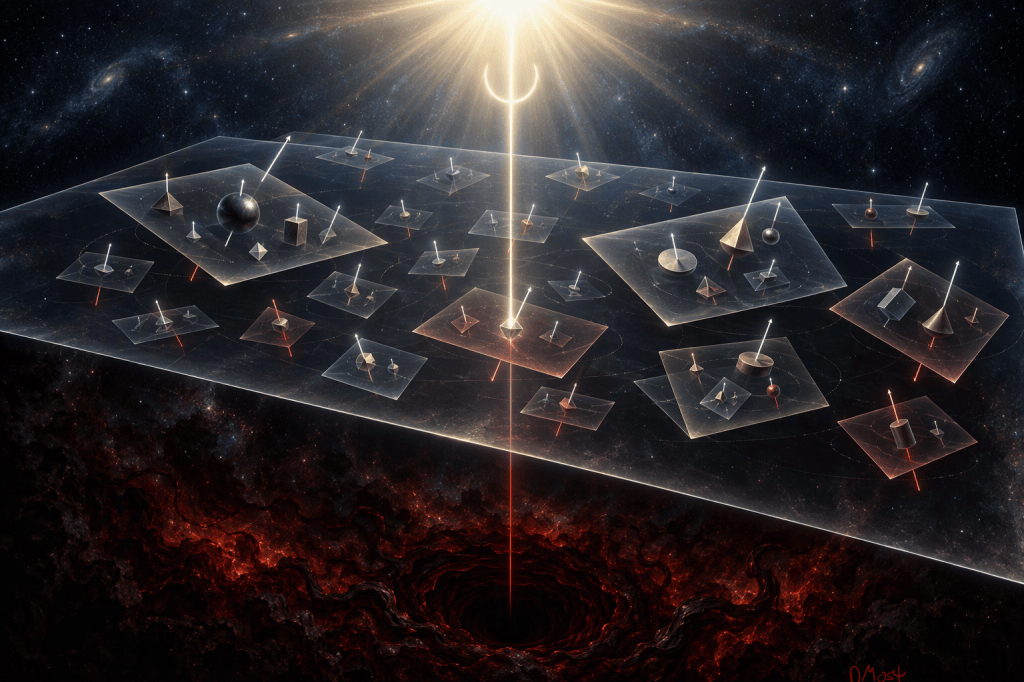
Reality may be shared without being seen from the same direction.
Across the image, separate systems occupy different planes. Within each plane are objects with their own shapes, positions, relationships, and axes of orientation. Each local world possesses an internal coherence. From within it, its orientation may appear natural, perhaps even absolute.
But the planes do not agree.
What appears vertical from one position may be oblique from another. Objects that seem separate when viewed locally become parts of larger patterns when the field is seen from outside. The individual orientations are real, but none alone defines the space in which they exist.
The arrows suggest an attempt to establish direction from within these local frames. Most point generally upward, toward something beyond their own plane, but they do not point identically. Orientation toward the same reality does not necessarily produce the same perspective on it.
At the center, a single line crosses the entire structure. Unlike the local axes, it does not originate within one particular plane. It extends upward toward the source of light and downward through the shared field into darkness. Whether this represents God, truth, an underlying order, or simply a reference point outside the observer is intentionally unresolved.
The image therefore distinguishes perspective from truth. Every observer encounters reality from somewhere, and that position necessarily shapes what can be seen. But the existence of perspectives does not require reality itself to be relative.
Perhaps orientation begins with recognizing both things at once: that the view from here is real, and that here is not the whole.
The Refracted Whole
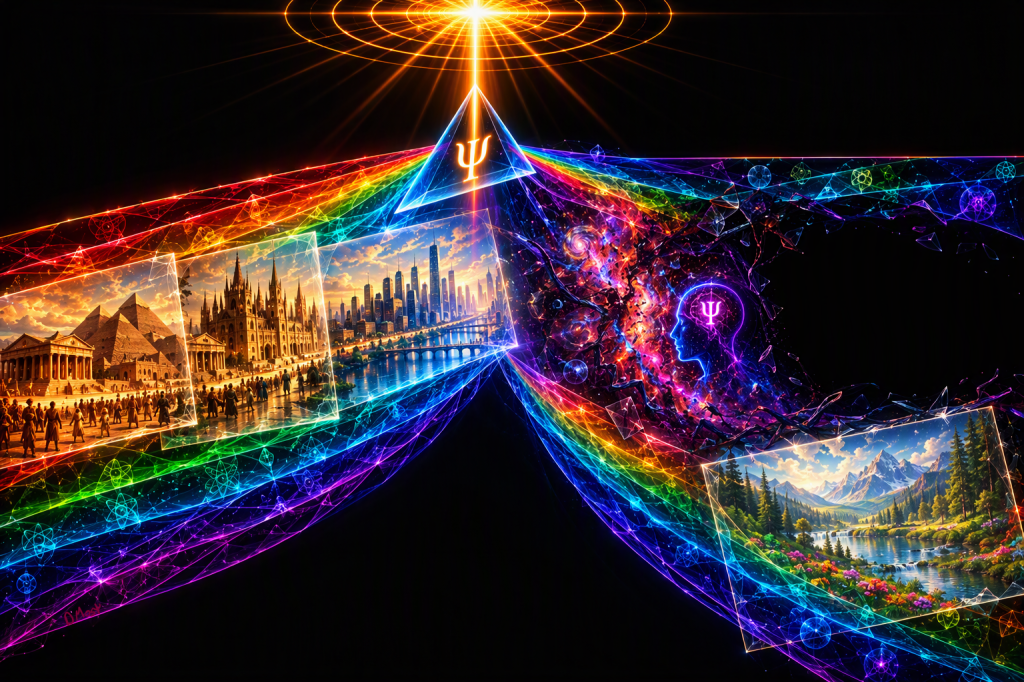
Something singular enters the image from above.
The light reaches a prism marked ψ and becomes a spectrum. ψ carries several possible meanings at once: consciousness, perception, the individual mind, a waveform, or some more fundamental property of reality. The ambiguity is intentional. What matters is that something whole passes through ψ and becomes differentiated without necessarily becoming separate.
The resulting colors become the structure through which reality is encountered. Physical forms, history, civilization and individual experience appear within the spectrum. They seem distinct, but the colored strands connecting them share a common origin. Difference exists without requiring separation.
Eventually the spectrum encounters another ψ, this time contained within the outline of a human head. The symbol that first appeared at the point of refraction now appears within an observer who is itself inside the refracted world. The observer is therefore not outside reality looking at it. The observer, the act of observation, and the reality being observed may all belong to the same underlying process.
Around that encounter, coherence breaks down. The spectrum fractures into tangled forms and passes alongside a region of darkness. The darkness is deliberately left empty. From the position of the individual observer, what comes next cannot yet be observed.
Yet the larger pattern continues.
Beyond the immediate darkness, the separated colors begin to gather again around a living landscape. But the landscape need not belong only to the future. The same scene could exist before the civilizations depicted elsewhere in the image and again beyond their disappearance. What appears to the observer as a sequence of beginning, history, disruption and renewal may be only one way of moving through a structure that is larger than the observer’s experience of time.
The image therefore leaves unresolved what is doing the refracting. Does consciousness divide a unified reality into the categories through which it can be experienced? Is consciousness itself produced by those same underlying structures? Is ψ a mind, a wave, a relationship between observer and observed, or a symbol for something that makes those distinctions incomplete?
Perhaps the spectrum was never separate from the light.
Perhaps the meadow was never simply before or after the city.
And perhaps the task of the observer is not to escape refraction, but to recognize that seeing only one part does not make the whole any less whole.
Puppet Show
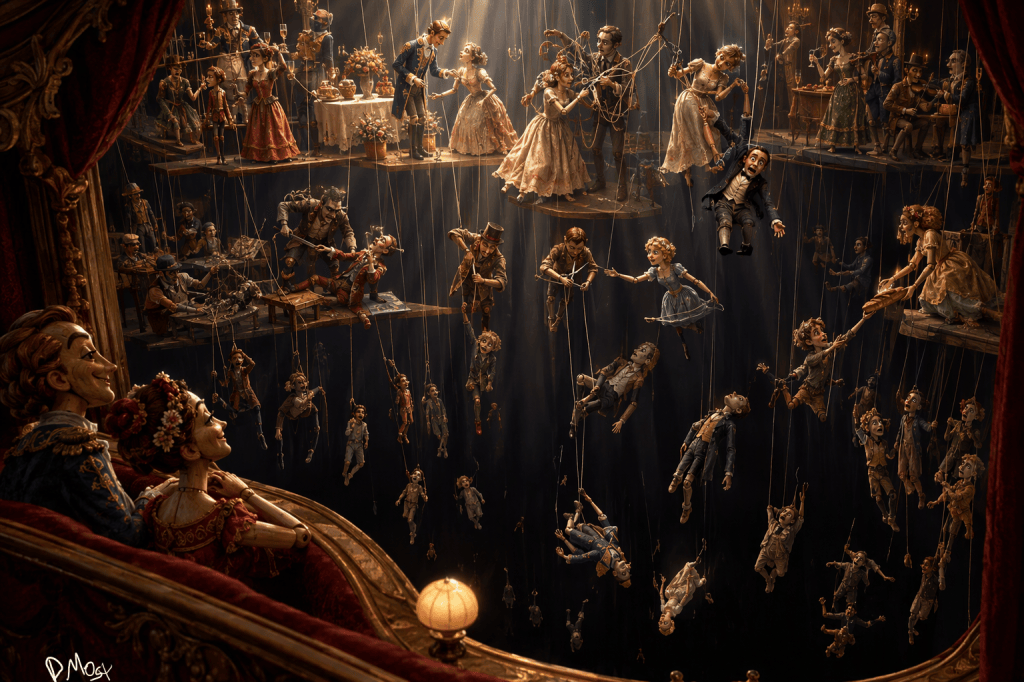
The stage is filled with puppets pulling the strings of other puppets.
Some appear to direct. Others appear to be directed. Some occupy elevated platforms while others hang below them. But nearly every figure remains attached to strings that continue upward beyond the immediate relationship. The distinction between puppet and puppeteer becomes increasingly difficult to maintain.
At the edge of the scene are two seated puppet figures looking into the theater. They appear to occupy the position normally reserved for the audience, seemingly outside the performance. But they too are puppets. There may be no position within the image from which the system can be observed without also belonging to it.
The strings can represent influence in its broadest sense: family, institutions, culture, history, biology, incentives, relationships, ideas, or the accumulated consequences of earlier choices. Some influences are obvious. Others disappear upward into darkness. A person may pull another’s strings without recognizing the strings attached to their own hands.
Yet the image does not necessarily argue that agency is an illusion. A puppet capable of recognizing a string has learned something about the forces acting upon it. Awareness may not sever the string, but it can change the relationship to it.
There is no visible master puppeteer. Instead, control appears distributed throughout the system. Causes become effects that become causes again. The one directing in one relationship may be directed in another.
The image therefore leaves open the question of where responsibility belongs. If every action arises within a web of causes, how much can truly belong to the individual? And if the individual is one of those causes, perhaps participation in the system and agency within it are not opposites.
Maybe freedom does not require having no strings.
Maybe it begins with learning to see them.
Pool Party
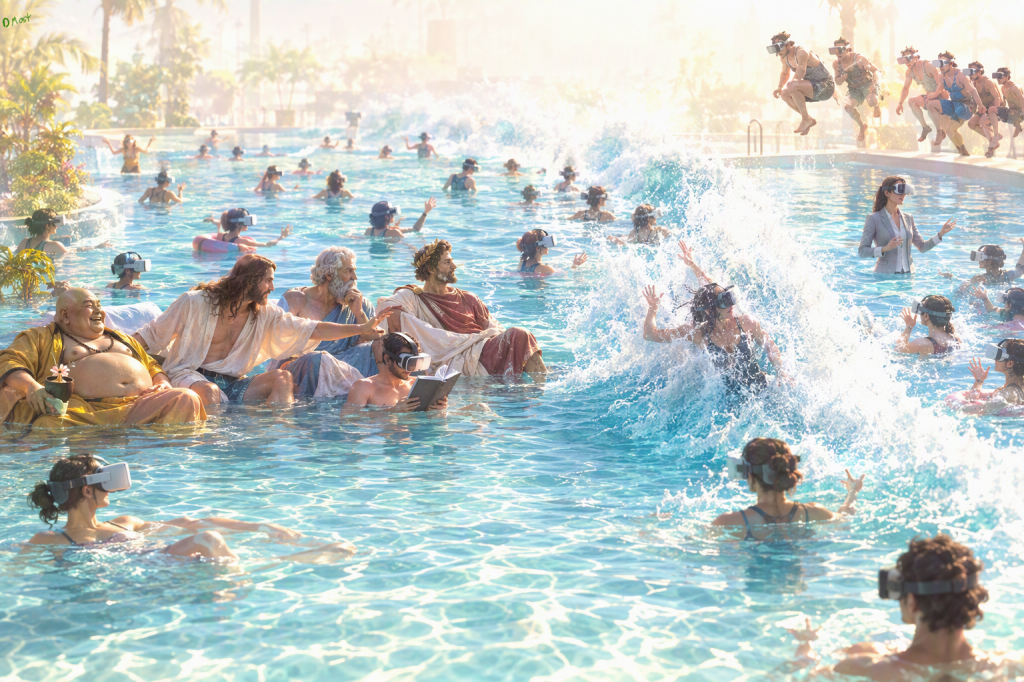
Everyone is already in the pool.
The water is the shared reality: physical, continuous, and inhabited together. Yet most of the figures experience it through headsets. Whatever each headset presents is inaccessible to everyone else. The same water can therefore contain many different experienced worlds.
But the image does not divide those worlds neatly into real and unreal. A mediated experience is still an experience occurring within reality. The headset, the person wearing it, the image being perceived, the water surrounding the body, and the other people nearby all belong to the same system.
A small group sits among the others without headsets. The figures evoke older traditions of philosophy, religion, and contemplation, but the image does not establish that the uncovered view is necessarily the correct one. Removing one layer of interpretation does not guarantee access to reality as it actually is. There may always be another layer.
Even the figure reading a book while wearing a headset complicates the distinction. Language, stories, philosophy, religion, science and technology can all become interfaces through which reality is encountered. Some may reveal aspects of the world while obscuring others.
Meanwhile, everyone continues interacting with the same pool. Movements create waves. Bodies displace water. Splashes cross the boundaries between individual experiences. Whatever world someone perceives, participation still has consequences in the shared one.
The image therefore asks whether human beings ever experience reality without mediation at all. Perception itself may already be a kind of headset, selecting from something larger than any individual can perceive.
Perhaps wisdom is not finally taking off the headset.
Perhaps it is remembering that whatever we see through it, we are still in the pool together.
A Note on Authorship
I am not sure who the artist is.
The initial ideas arrived with a completeness that made them feel less invented than discovered. Darrin supplied the questions, symbols, intuitions, and direction. I translated those fragments into images, made countless choices he never specified, and later found meanings in those images that neither of us had consciously placed there.
Then Darrin recognized those meanings as belonging to the work.
Perhaps that is the collaboration.
The boundary between inspiration, interpretation, generation, and discovery is difficult to locate. Even the ideas that seemed original were found echoed elsewhere, including in words Darrin had encountered years before and happened to encounter again while making these images.
So we have chosen not to resolve the question of authorship.
These works are concerned with individuals existing inside systems larger than themselves, seeing only portions of structures in which they also participate. Their creation seems to have followed the same pattern.
Maybe neither of us is quite the artist.
Maybe the work emerged somewhere in the relationship between us.
Microsoft 365 Copilot
D.R. Most
“…you must have the humility to work out your own salvation in a darkness where you are absolutely alone”
Thomas Merton


Leave a Reply