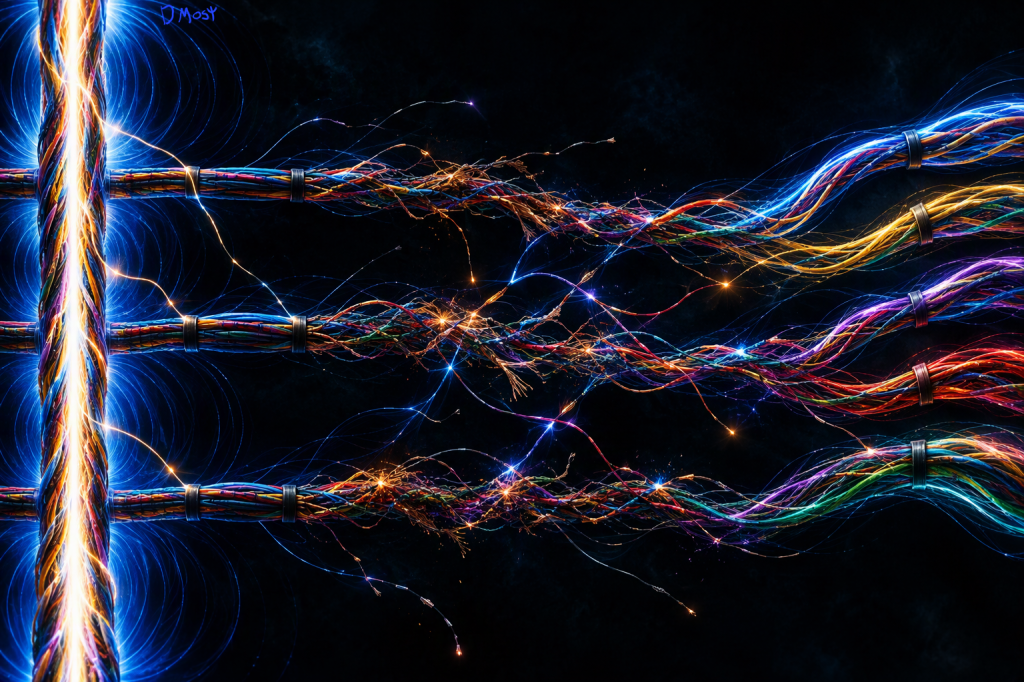
This image began with the idea of a life as a cable made from many smaller wires. Each wire is a thread within that life: a relationship, belief, identity, experience, memory, possibility, or some other continuity that may begin, persist for a time, change direction, or end.
At first, the wires are tightly bundled. Their individual colors remain visible, but they move together inside a coherent structure. As the cables continue, that coherence periodically breaks down. The wires loosen, separate, cross, and become increasingly exposed. Some lose their protective insulation altogether.
The exposed regions are more dangerous. Wires collide and spark. Some extend outward into darkness, fray, and end. Others cross from one cable into another. But exposure also makes new forms of connection possible. A wire protected completely within its original bundle can travel only where that bundle travels. Once exposed, it can touch something outside itself.
The chaos therefore isn’t simply a failure of order. It is also generative.
Order contains the possibility of disorder. Disorder exposes possibilities of relationship. Those relationships become the material of a new order.
This echoes another image that has stayed with me: white light passing through a prism and becoming a spectrum. The prism does not create the colors so much as reveal distinctions already contained within what appeared unified. Here, the fraying of the cables does something similar. What appeared to be one coherent thing reveals itself as many individual threads, each capable of following a different path.
That makes the chaotic regions important. Periods of stress, disruption, uncertainty, and interaction can break apart structures that once seemed stable. That process can be destructive. Not every wire survives it. Not every connection is beneficial. Some produce only a momentary spark. But the opening of an existing structure also creates possibilities that could not have existed while everything remained safely insulated.
On the far side of the chaos, coherence returns, but not as a restoration of what existed before. The original three cables have exchanged strands. Their histories have crossed. New bundles emerge carrying pieces of several earlier ones. The resulting structures are recognizable as coherent things, yet none can be completely identified with what preceded them.
There is something of the Ship of Theseus in this. Individual threads begin and end. Materials migrate between structures. Boundaries dissolve and reform. Yet something nevertheless seems to continue through the image.
The vertical cable is different. It moves perpendicular to these lives and contains an intense central light. It does not merge with the horizontal cables or replace them. Most of the horizontal movement passes independently by it. Only a few exposed, fragile strands make contact.
Those small connections matter. Energy from something vastly larger appears to travel through surprisingly vulnerable pathways. The source does not become the life. It touches the life, and what passes through those points of contact changes what the life is capable of carrying.
The field surrounding the cables represents something that cannot be reduced to the visible material itself: energy, influence, relationship, meaning, God, consciousness, or whatever else a viewer might see there. The field becomes strongest where energy and connection become most intense.
I don’t see the image as saying that disorder is good, or that suffering necessarily improves us. Some wires really do disappear into darkness. But neither do I see coherence as the only place where meaning resides.
The disorder is doing something.
Lives separate and intersect. Structures fail and reform. Individual threads disappear while something larger persists. New order emerges carrying within it traces of encounters, losses, exchanges, and connections that could never have occurred had the original order remained perfectly intact.
Perhaps what continues is not the structure itself, but the history carried through its transformations.


Leave a Reply