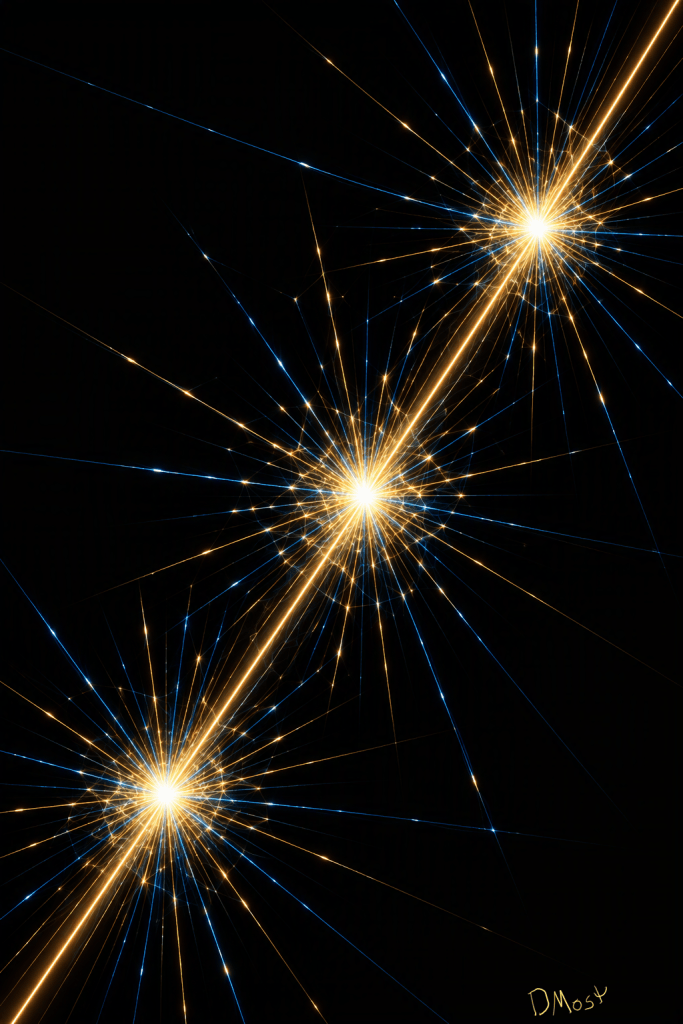
The Distance Between began with a simple geometry: a center, paths radiating outward from it, and the changing distance between those paths.
Each bright center represents a place of maximum relationship. Near the center, neighboring paths are close. Movement among them is easy, information can pass freely, and many possible directions remain accessible. As the paths extend outward, each remains intact. Light continues to move rapidly along it. Nothing about the individual path is necessarily broken or false.
What changes is the distance to everything else.
The farther outward a path travels, the farther it becomes from neighboring paths. Connections grow longer, rarer, and more precarious. Eventually a path can remain bright, active, and coherent while becoming almost completely isolated. The danger is not necessarily losing one’s way. It may be becoming increasingly unable to reach anything outside that way.
The work imagines consciousness in similar terms. A life can travel great distances along a particular identity, belief, habit, expertise, grievance, certainty, or way of understanding the world. Continuing along an established trajectory may be effortless. Crossing directly to another trajectory becomes increasingly difficult as the distance between them grows.
Yet the geometry suggests another possibility.
Instead of constructing an ever longer and more fragile bridge to a distant path, one can reverse course. Moving toward the center naturally reduces the distance between paths. What seemed impossibly remote begins to draw nearer without either path having to disappear.
The “center” here owes something to the idea of returning to the center in Lao Tzu: not a destination that prescribes one correct path, but a movement toward a condition in which fewer possibilities have been excluded. At the center, individuality does not vanish. The paths remain distinct. They are simply close enough to remain in relationship.
The luminous axis passing through the centers suggests a source running through individual structures without becoming identical to them. Around that source, paths diverge, signals move, relationships form and weaken, and individual trajectories extend beyond what can be seen.
The darkness at the edges is therefore not evil, ignorance, or absence. The distant paths remain illuminated.
They are simply far apart.
Perhaps the measure of isolation is not how far we have traveled, but the distance between us.


Leave a Reply